import matplotlib.pyplot as plt
import numpy as np
from sklearn.linear_model import LinearRegression, LogisticRegression

def sigmoid(z):
    return 1 / (1 + np.exp(-z))

# Set seed for reproducibility
np.random.seed(0)

# Generate a toy dataset
N = 5
x_class1 = np.random.normal(2, 1, N)
x_class2 = np.random.normal(0, 1, N)

y_class1 = np.ones(N)
y_class2 = np.zeros(N)


# Features and labels, with and without outlier
X = np.concatenate((x_class1, x_class2)).reshape(-1, 1)
y = np.concatenate((y_class1, y_class2))

# Fit linear regression
ols = LinearRegression()
ols.fit(X, y)

# Fit logistic regression
clf = LogisticRegression()
clf.fit(X, y)

# Generate test data for plotting
X_test = np.linspace(-5, 10, 300).reshape(-1, 1)
y_test = ols.predict(X_test)
logistic_prob = sigmoid(clf.coef_ * X_test + clf.intercept_)

# Plotting
plt.figure(figsize=(10, 5))

# plot data
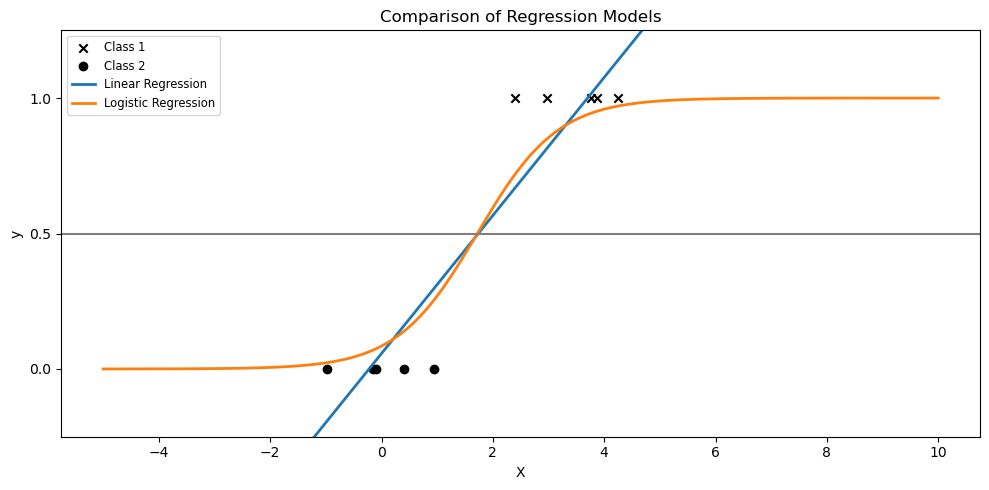
plt.scatter(x_class1, y_class1, label='Class 1', marker='x', color='k')
plt.scatter(x_class2, y_class2, label='Class 2', marker='o', color='k')

# Without extra points
plt.plot(X_test, y_test, label="Linear Regression", linewidth=2)
plt.plot(X_test, logistic_prob, label="Logistic Regression", linewidth=2)


plt.title("Comparison of Regression Models")
plt.axhline(0.5, color=".5")
plt.ylabel("y")
plt.xlabel("X")
plt.yticks([0, 0.5, 1])
plt.ylim(-0.25, 1.25)
plt.legend(loc="upper left", fontsize="small")
plt.tight_layout()
plt.show()